Restostar: Turning Unhappy Diners into Private Conversations
The story behind a startup idea that rethinks restaurant reputation management — routing feedback by sentiment so that every review works for the restaurant, not against it.
The Problem
Walk into any restaurant and ask the owner what keeps them up at night. Somewhere near the top of the list — right after food costs and staffing — you will hear the same answer: online reviews.
A single 1-star review on Google or Yelp can undo months of goodwill. Worse, most negative reviews are posted by guests who never told the staff anything was wrong. They smile, pay the bill, walk out — and then vent to the internet. The restaurant learns about the problem only after the damage is public and permanent.
The core paradox: The guests most willing to leave feedback are the angriest ones, and the only channel available to them is a public review site. Happy guests rarely bother. The system is structurally rigged against restaurants.
Existing solutions fall into two camps. Review-aggregation dashboards that let owners monitor the damage after it happens. Or pushy "tap-to-review" kiosks that treat every customer identically, annoying happy guests and giving unhappy ones a megaphone. Neither addresses the root cause: the feedback channel itself needs to be smarter.
The Solution
Restostar is a sentiment-aware feedback funnel for restaurants. Instead of sending every guest to the same review page, it asks a single, fast question about their experience and then routes them based on how they feel:
Happy Guest
Guided to leave a public review on Google, Yelp, or TripAdvisor — with a pre-filled prompt that makes the process frictionless. The restaurant earns organic positive visibility.
Unhappy Guest
Redirected to a private feedback form that goes straight to the owner's dashboard. The issue gets resolved behind closed doors — before it ever becomes a public review.
The result is a win-win. Guests feel heard regardless of sentiment. Restaurants increase their public star ratings organically while catching operational problems early. No gimmicks, no fake reviews — just smarter routing.
"What if the feedback channel itself was intelligent enough to know where each piece of feedback should go?"
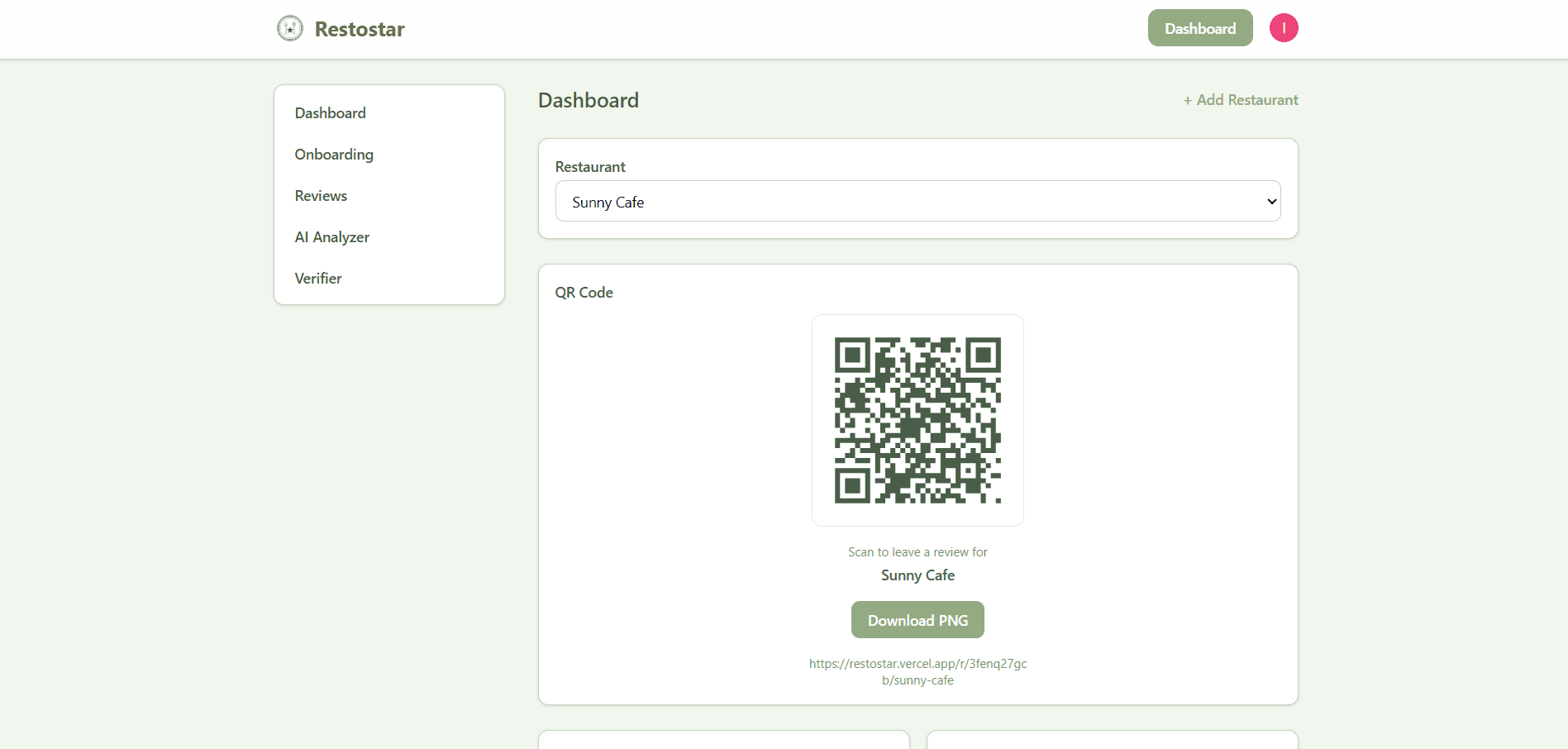
Features & Highlights
The MVP was scoped around four capabilities that directly validate the hypothesis: can a sentiment-based routing system measurably shift a restaurant's public reputation?
Smart Sentiment Routing
A lightweight questionnaire gauges guest satisfaction in under 10 seconds. Positive sentiment triggers a public review prompt; negative sentiment opens a private channel. The routing logic is configurable per restaurant.
Instant Owner Alerts
When critical feedback arrives — low ratings or specific keywords like 'food poisoning' or 'rude' — the owner gets an immediate notification via email and in-dashboard alert. Response time drops from days to minutes.
Analytics Dashboard
Tracks feedback volume, sentiment trends over time, resolution rate, and public review conversion. Owners can see which shifts, menu items, or staff interactions correlate with negative feedback.
Zero Negative Public Reviews (Pilot)
During the initial pilot period, every piece of negative feedback was captured privately. Zero negative reviews made it to public platforms — not because they were suppressed, but because they were resolved first.
Pilot Results
Tech Stack & Architecture
The architecture was designed for speed-to-market. As a solo founder building an MVP, every technology choice was evaluated on a single criterion: does this let me validate the idea faster, or does it add complexity I don't need yet?
Frontend
- Next.js — App Router for SSR and static generation
- React 19 — Component-driven UI with server components
- Tailwind CSS — Rapid, consistent styling
- Vercel — Deployment with edge functions and analytics
Backend & Data
- Node.js API routes — Lightweight serverless functions
- Database layer — Feedback storage and analytics queries
- Sentiment analysis — Keyword-based + threshold scoring
- Email notifications — Transactional alerts to owners
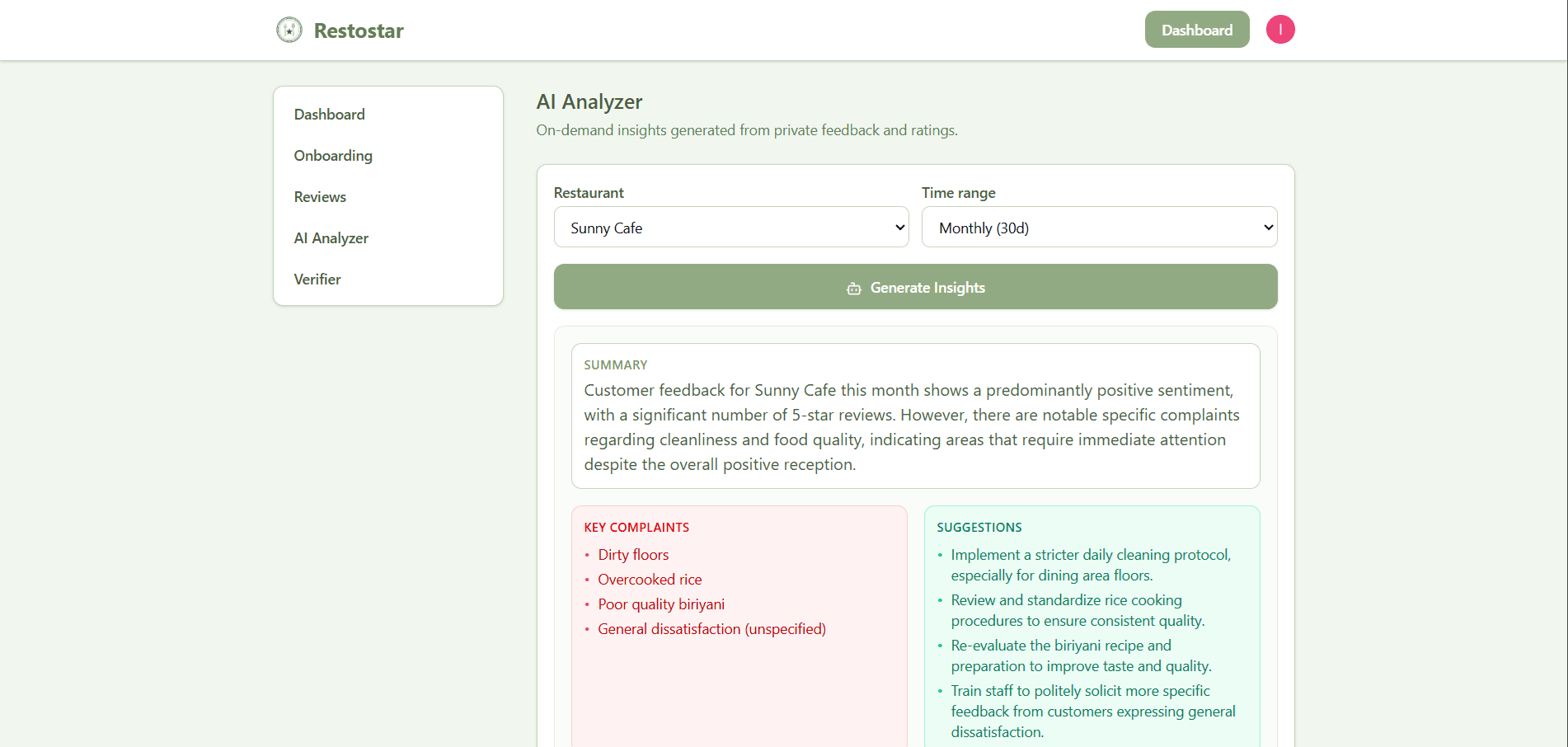
Architecture principle: The system was built as a monorepo with clear separation between the guest-facing feedback flow (public), the owner dashboard (authenticated), and the routing/notification engine (server-side). This makes it straightforward to swap out the sentiment engine later without touching the UI.
Challenges & Learnings
Building Restostar from zero to a working pilot taught me more about product thinking than any framework or methodology could. Here are the lessons that stuck:
Scope is the enemy of shipping
The first version of the PRD had 23 features. The shipped MVP had 4. Every feature I cut hurt — but each one also brought the launch date closer by a week. The hardest product decision isn't what to build; it's what to deliberately leave out.
Talk to restaurant owners, not restaurant tech
Early user research showed that owners don't think in terms of 'sentiment analysis' or 'NLP pipelines.' They think in terms of 'that table that looked unhappy' and 'I wish I'd known before they left.' The language of the product had to match their mental model, not mine.
The routing threshold is the product
Getting the sentiment threshold right — the line between 'route to public review' and 'route to private feedback' — turned out to be the most consequential design decision. Too aggressive and you funnel lukewarm guests to private (losing potential positive reviews). Too lenient and genuinely unhappy guests end up on Google.
Speed of feedback loop > accuracy of analysis
Owners cared less about a detailed sentiment breakdown and more about getting alerted fast. The first version had a sophisticated analytics view that nobody used in the pilot. The instant alert feature — a simple email — was the most praised capability.
"I went in thinking I was building a dashboard. I came out realizing I was building an early warning system."
What's Next
Restostar started as a hypothesis. The pilot validated the core loop. Here is where I want to take it:
AI-Powered Sentiment Engine
Replace the keyword-based routing with an LLM-backed sentiment classifier that understands nuance, sarcasm, and multilingual feedback. This lifts accuracy from ~80% to 95%+ and removes the need for manual threshold tuning.
In ProgressMulti-Location Support
A single dashboard for restaurant groups and franchises. Aggregate analytics across locations, benchmark performance, and identify systemic issues vs. location-specific ones.
PlannedIntegration Ecosystem
Direct integrations with POS systems, reservation platforms (OpenTable, Resy), and CRM tools. Auto-trigger feedback requests after a guest's visit without any staff involvement.
ExploringPublic Review Response Assistant
An AI-assisted tool that helps owners craft professional, empathetic responses to the public reviews that do make it through. Tone-matched to the restaurant's brand voice.
Exploring